Imagine you’re at a party and trying to find your friend who told you they would be near the snack table. Instead of shouting their name repeatedly, you look for contextual clues: a familiar laugh, their favorite snack in hand, or their distinct outfit. This is, in essence, how semantic search works—it’s all about context and understanding the deeper meaning behind queries.
But the whole discussion concludes with the question “What is it & how would Semantic Search affect you as an ecommerce merchant?”, this is exactly what our AI solutions for ecommerce has answered in the guide below. Read on to learn more!
What Is Semantic Search?
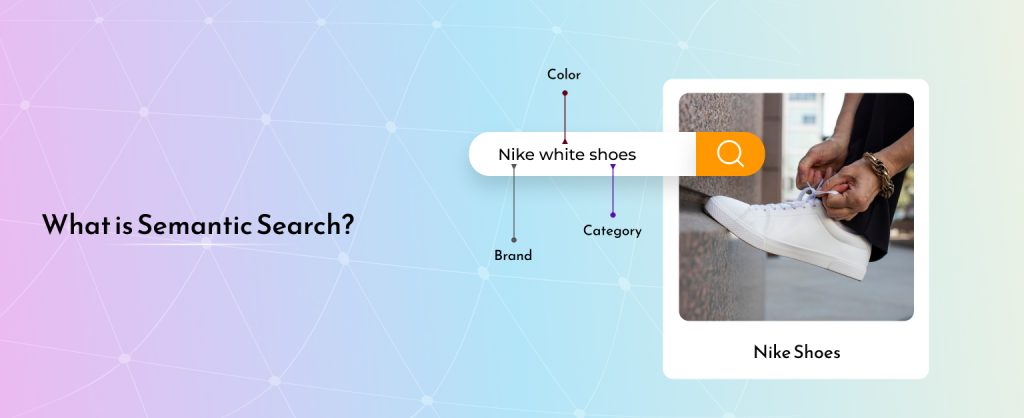
Semantic search is a technique that seeks to improve search accuracy by understanding the searcher’s intent and the contextual meaning of terms as they appear in the searchable data space, whether on the web or within a closed system. Unlike traditional search engines that rely heavily on keyword matching, semantic searching leverages natural language processing (NLP) and machine learning to interpret the user’s query in a more human-like manner.
Key Aspects of Semantic Search:

Context Understanding

User Intent

Content Relevance

Result relevancy
By moving beyond simple keyword matching, AI semantic search aims to deliver results that are more aligned with what the user is actually looking for, thus enhancing the overall experience.
What are the Semantic Search Technologies?
To truly appreciate this search, we need to peek under the hood and understand the technologies powering it. We have some of the best model for semantic search and knowledge graphs that are widely used for this purpose. Let’s have a closer look at both of them in details:
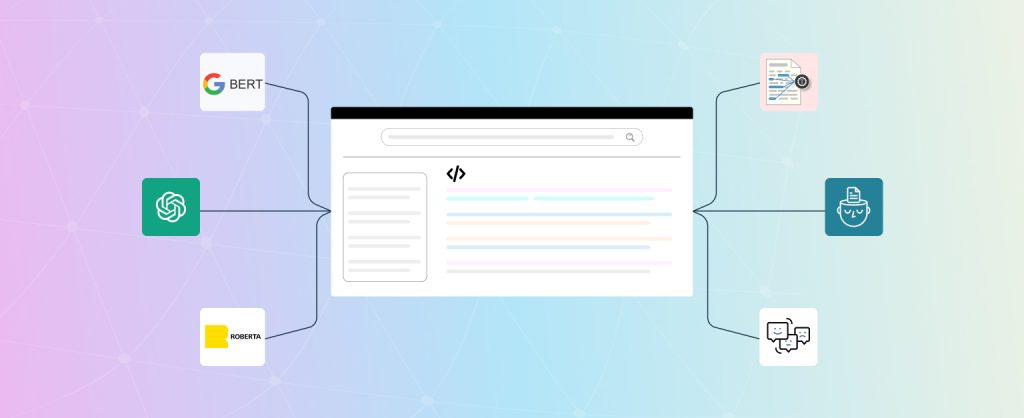
How Is NLP Used in AI Semantic Search?
NLP plays a pivotal role in this kind of search by enabling machines to understand human language nuances. Semantic search NLP is integral for interpreting and processing search queries effectively.
Key NLP Models in Semantic Search
- BERT for Semantic Search: BERT excels at understanding the context of words, making it highly effective for this search. Explore BERT.
- GPT-3: GPT-3’s language generation capabilities also contribute to better understanding and processing of search queries. Learn about GPT-3.
- RoBERTa (Robustly optimized BERT approach): An optimized version of BERT, RoBERTa further enhances contextual understanding. Discover RoBERTa.
How NLP Enhances Semantic Searching
- Contextual Understanding: NLP helps in understanding the context around search terms, leading to more accurate results.
- Entity Recognition: Identifies entities (people, places, things) within queries to fetch relevant information.
- Sentiment Analysis: Analyzes the sentiment behind queries to better understand user intent.
Knowledge Graphs
Knowledge graphs store information in a way that reflects relationships between entities, enabling search engines to fetch relevant data based on these connections. Google’s Knowledge Graph is a prime example, enhancing its search engine’s ability to understand facts about people, places, and things.
What are the Benefits of Semantic Search?
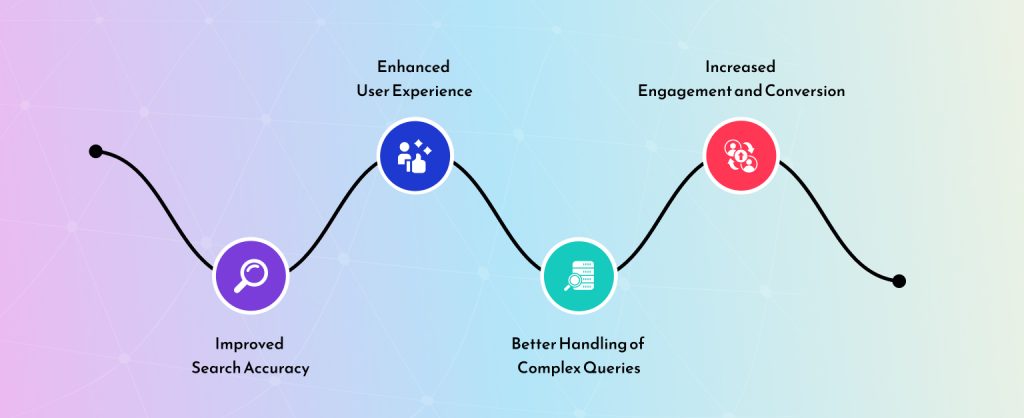
Personalized search brings a host of benefits that make it an attractive option for businesses and users alike.
— Improved Search Accuracy: By understanding the context and intent behind queries, personalized search delivers more accurate results, reducing the time users spend searching for information.
— Enhanced User Experience: A better understanding of user intent leads to more relevant search results, significantly improving the user experience. This relevance keeps users engaged and satisfied.
— Better Handling of Complex Queries: Traditional search engines often struggle with complex, multi-faceted queries. This search can break down these queries and understand their components, delivering more comprehensive results.
— Increased Engagement and Conversion: For eCommerce businesses, providing relevant search results can lead to higher user engagement and increased conversion rates. When users find what they are looking for quickly and easily, they are more likely to make a purchase.
How Does Semantic Search Work?

Understanding the inner workings of semantic searching involves delving into its core processes—insights that an AI expert for eCommerce can leverage to optimize product discovery and enhance user experience.
Query Parsing
The first step is query parsing, where the engine breaks down the user’s query into understandable components. This also includes identifying keywords, context, and intent. Defining personalized search basically starts with this fundamental step.
Context Analysis
Next, the search engine analyzes the context of the query. It also looks at the surrounding words, previous queries, and user behavior to determine what the user is actually searching for.
Matching and Retrieval
Using NLP and machine learning models, the search engine matches the parsed query with the most relevant documents in its index. This process also involves semantic matching, where the engine looks beyond keywords to understand the meaning behind the words.
Ranking Results
Finally, the search engine ranks the results based on relevance and presents them to the user. This ranking also considers various factors, including content quality, relevance to the query, and user engagement metrics.
Traditional Search vs Semantic Search
Understanding the differences between traditional search and personalized search is crucial for appreciating the latter’s advantages which are as following.
| Feature | Traditional Search | Semantic Search |
| Implementation | Simple and straightforward | Complex and resource-intensive |
| Context Understanding | Limited understanding of the context | Excellent contextual understanding |
| User Intent Interpretation | Struggles with intent | Accurately interprets user intent |
| Relevance of Results | Often irrelevant results | Highly relevant results |
| Keyword Dependency | High dependency on exact keywords | Low dependency, focuses on meaning |
| Handling Complex Queries | Limited capabilities | Handles complex queries effectively |
| User Experience | Basic and often frustrating | Enhanced and satisfying |
| Accuracy of Results | Moderate accuracy | High- Intent search results |
| Maintenance | Easier to maintain | Complex to maintain |
Boost your eCommerce search experience with our advanced artificial intelligence development services!
What Semantic Search Means for Your Ecommerce Store?
Getting on board with this isn’t just about keeping up with trends. Altogether It’s about ensuring your website provides the best user experience possible. Without it, you further risk frustrating your visitors and losing potential customers.
What if Semantic Search is Ignored?
Imagine a customer, let’s call him John, who visits your site looking for a specific item—a pair of size 9 black running shoes under $100. However, your site only uses a traditional keyword-based search. John types in his query, but the search engine fails to understand the nuances of his request. Instead of finding the exact item he wants, the search returns irrelevant results: a pair of red running shoes, black dress shoes, size 8 grey running shoes.
John then tries different variations—”black running shoe size 9,” “running shoes under $100,” “black athletic shoes”—but none of the results match his needs. Frustrated, John leaves your site & heads back to Google to find another retailer that understands his query better. Just like that, you’ve lost a potential sale.
Implement Semantic Site Search for Better User Experience
This search bridges this gap by interpreting the meaning behind search queries, rather than just matching keywords. This also means John’s search for “size 9 black running shoes under $100” would return exactly what he’s looking for, keeping him engaged and increasing the likelihood of a purchase.
By implementing personalized search, you enhance your website’s user experience, making it easier for visitors to find what they need quickly and efficiently. This not only improves customer satisfaction but also boosts your conversion rates and keeps you competitive in the ever-evolving digital marketplace.
Ready for the Next Step?
As you now know everything about AI semantic search, it’s time to enhance your website’s search capabilities. Implementing a semantic searching engine can be simple and efficient with the right solution. Look for a solution that is easy to set up without requiring extensive coding skills, yet offers the flexibility for customization.
This intent-driven discovery isn’t limited to e-commerce products. Similar AI-powered semantic search powers advanced property matching in real estate websites — where buyers search with natural language like ‘family home near good schools under $500k’ and get highly relevant, personalized listings based on context and behavior. Discover how real estate platforms leverage AI for intelligent search, personalized recommendations, and enhanced user journeys in this guide: AI in Real Estate Software Solutions.
Frequently Asked Questions
Semantic search is a technique that improves search accuracy by understanding the searcher’s intent and the contextual meaning of terms in a search query.
Hire AI Developers to build and integrate intelligent semantic search solutions tailored to your business needs.
This kind of search works by parsing queries, analyzing context, matching and retrieving relevant documents, and ranking results based on relevance.
Benefits include improved search accuracy, enhanced user experience, better handling of complex queries, and increased engagement and conversion rates.
bert for semantic search & NLP is used to understand the nuances of human language, including context, entity recognition, and sentiment analysis.
This search enhances product discovery, personalizes the shopping experience, increases conversion rates, and provides a competitive advantage.
The cost of implementing semantic search varies based on your specific requirements and the complexity of your data. For a detailed quote and tailored solution, please contact our plugin development company.
Summing Up
Adopting semantic search is more than just a technological upgrade; it’s a strategic move to stay competitive in the digital marketplace. With its ability to understand context, user intent, and deliver highly relevant results, semantic searching can drive higher conversion rates and customer loyalty. As we move further into 2024, importance of implementing semantic search technologies can’t be overstated.
To see how semantic search works in real estate ecommerce, check out guide on AI in real estate.
At The Brihaspati Infotech, our expert team will tailor a solution that fits your unique needs, enhancing your site’s search capabilities.
Let us help you upgrade your search functionality and elevate your user experience. Contact us
Stay Tuned for Latest Updates
Fill out the form to subscribe to our newsletter