Shopify Product bundles should be the easiest win in ecommerce—boosting AOV and conversions without extra ad spend. Yet many Shopify stores see the opposite: slow pages, broken discounts, and abandoned carts.
The issue isn’t bundling itself; it’s the architecture behind it. Legacy apps rely on ‘Draft Order’ hacks or heavy scripts that feel bolted on instead of built in. This creates a ‘trust gap’ at the most critical moment: the checkout.
In 2026, merchants can’t afford these technical hurdles. Shopify’s platform has evolved, and modern Shopify app development demands bundle solutions that are invisible, fast, reliable, and fully native to checkout. Anything less risks losing revenue.
Here is what most bundle apps are still missing—and why those gaps matter more than ever.
Why Do Most Shopify Product Bundles Apps Fall Short?
Merchants often install bundle apps expecting quick wins: higher Average Order Value (AOV), smoother upsells, and effortless product bundling. But in practice, many Shopify product bundles apps fall short because they’re built on outdated foundations.
To make this clear, here’s a quick overview table contrasting legacy bundle apps with modern bundling solutions.
| Feature | Legacy Bundle Apps (Old Way) | Modern Bundling Engine (The New Way) | Why It Matters |
|---|---|---|---|
| Discount Logic | Draft Orders: Redirects to manual invoice. Breaks “Welcome” discount codes. | Shopify Functions: Native checkout logic. Allows discount stacking & works with all codes | Prevents cart abandonment caused by broken coupons. |
| Inventory Sync | Manual/Delayed: Often oversells because it doesn’t “see” component stock in real-time. | Real-time SKU-level sync: Bundle stock automatically calculated from components | Prevents “Out of Stock” emails and refund headaches. |
| Storefront Integration | Messy Liquid snippets. Heavy JavaScript slows down site. | Theme App Extensions: Drag-and-drop blocks. Zero impact on site speed (Shopify CDN). | Higher SEO rankings and better mobile conversion rates. |
| Bundle Types | Fixed sets only (e.g., Product A + B). | Mix-and-Match / Variants: Dynamic “Build a Box” or variant-based selection. | Encourages customers to buy more by giving them a choice. |
| App Uninstallation | “Ghost” code left behind, breaking theme files | Clean removal: Removing the app instantly clears all files. | Keeps your store’s backend clean and bug-free. |
| Recurring Revenue | One-time purchases only. | Native subscriptions: Easily bundle recurring kits/routines. | Unlocks predictable revenue streams and higher LTV. |
| Data & Insights | Basic or non-existent dashboard | Advanced analytics: Track conversion rates & top-performing bundles. | Enables optimization and smarter merchandising decisions. |
| Fulfillment | Manual kit assembly or broken SKUs. | Automated sync: Components flow perfectly to your 3PL/warehouse. | Reduces operational overhead and fulfillment errors. |
What’s Missing in Shopify Product Bundles Apps? (In Detail)
The quick overview table highlights the gaps, but each shortcoming deserves a closer look. Most Shopify product bundles apps fail not because product bundling is flawed, but because their architecture hasn’t kept pace with Shopify’s evolution.
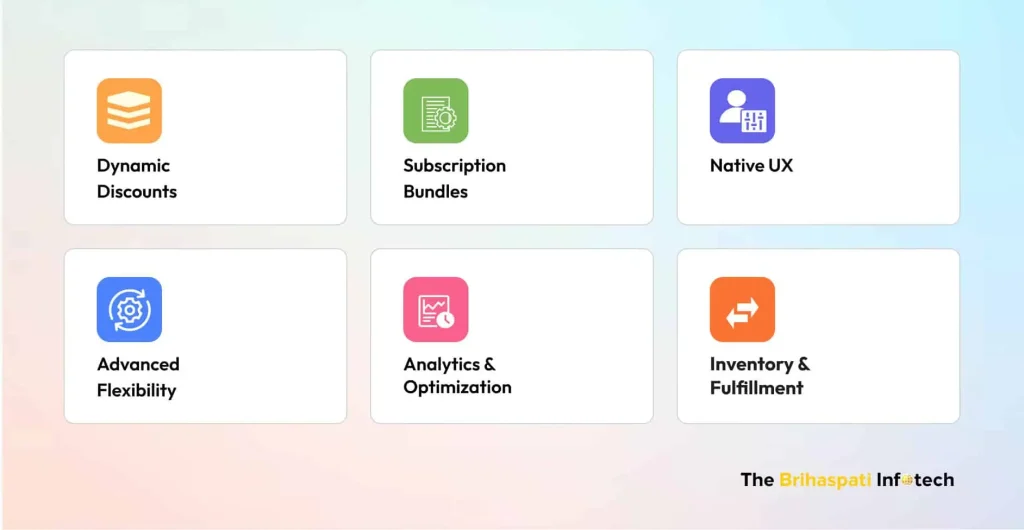
1. Dynamic Discounts (The Trust Factor)
- Discounts are easy to display but often fail at checkout, with Draft Orders and cart hacks causing errors.
- Inconsistent discounts erode trust and drive cart abandonment.
- Native Shopify Functions keep pricing reliable and friction‑free, even in high‑traffic events.
2. Subscription Bundles (The Retention Factor)
- Standard bundles are often one‑time offers, missing the huge opportunity for recurring revenue.
- One‑time sales are short‑term wins; subscription bundles create lasting customer relationships.
- Flexible subscription options for bundles, allowing merchants to offer recurring deliveries or memberships.
3. Native UX (The SEO & Performance Factor)
- Many apps use overlays or iframes, which slow down page speed, hurt mobile conversions, and negatively affect SEO.
- Google considers site speed a ranking factor, and slow bundles kill mobile user experience, where most traffic comes from today.
- Fully native, lightweight integration that feels like part of the Shopify store, not an add‑on.
4. Advanced Flexibility (The Personalization Factor)
- Pre‑built bundles are rigid, limiting customer choice.
- Shoppers convert more when bundles match their preferences; fixed sets often fall short.
- “Build Your Own Bundle” (BYOB) options, allowing shoppers to customize bundles without friction.
Taking personalization even further, Shopify Agentic Commerce lets AI agents analyze customer queries and behavior in real time to suggest dynamic, tailored bundles directly in chat — turning static product sets into conversational upsells and purchases. Learn how to enable this: How to Sell in AI Chats with Shopify Agentic Commerce in 2026?
5. Analytics & Optimization (The Data Factor)
- Basic reporting on sales is common, but deep insights are rare.
- Without analytics, merchants can’t tell which bundles are working or identify products dragging AOV down.
- Detailed dashboards highlight sales trends and bundle performance, empowering merchants with insights.
6. Inventory & Fulfillment (The Operations Factor)
- Some apps fail to sync accurately with stock, leading to overselling or failed orders.
- Inventory mistakes create customer dissatisfaction and operational headaches.
- Real‑time sync across Shopify, warehouse, and fulfillment keeps stock accurate and orders seamless.
Taken together, these shortcomings explain why so many Shopify product bundles apps fail to deliver on their promise. From trust and retention to SEO, personalization, data, and operations, each missing piece directly impacts revenue and customer experience. To unlock real growth, merchants need solutions built with modern Shopify app development principles, not outdated workarounds.
How We Built a Modern Shopify Product Bundles Solution?
At The Brihaspati Infotech, we developed a public Shopify product bundles app designed to feel native to Shopify’s checkout. From the start, the focus was on solving the six critical factors merchants struggle with — trust, retention, performance, personalization, data, and operations — not as add‑ons, but as core features built directly into the app’s architecture.
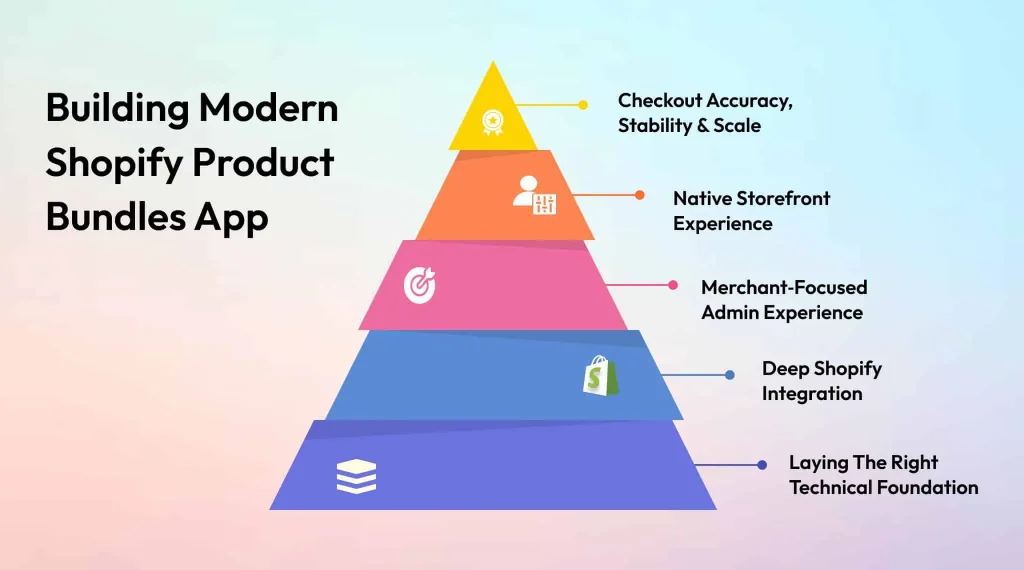
Step 1: Laying the Right Technical Foundation
We started with a server‑rendered Remix setup, backed by Node.js and TypeScript for long‑term maintainability.
A PostgreSQL database with Prisma ORM was used to model bundles, products, discounts, subscriptions, and analytics — keeping the data layer flexible and scalable from the beginning. This ensured the app could handle complex product bundling scenarios without performance trade‑offs.
Step 2: Deep Shopify Integration
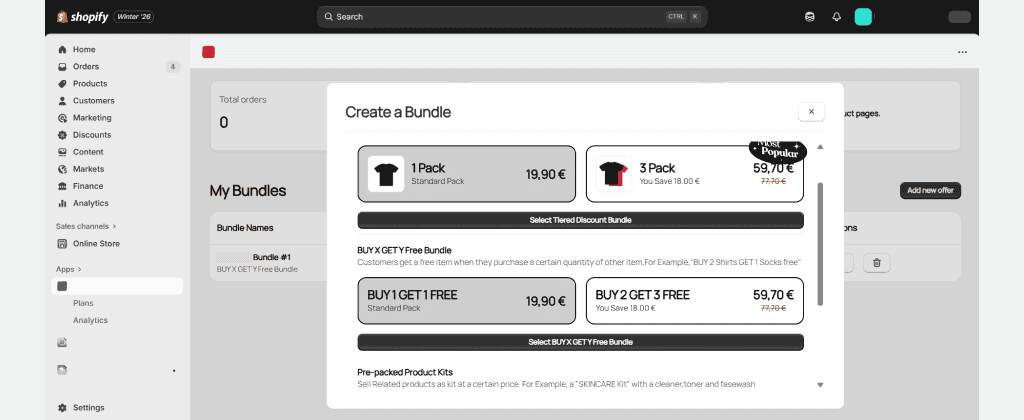
The app was registered through the Shopify Partners Dashboard and secured using OAuth 2.0.
We integrated Shopify’s GraphQL and REST APIs to fetch products, collections, and variants, while discount and selling plan APIs handled bundle pricing and subscription logic directly within Shopify’s ecosystem.
This API-driven foundation also enables powerful data unification. Our Shopify data sync app for smarter sales insights centralizes product, order, and inventory data across multiple stores in real time — delivering actionable analytics, trend tracking, and accurate stock visibility to optimize bundle performance and merchandising decisions.
This deep integration positioned the app among the best product bundle apps for Shopify by ensuring merchants could manage everything natively.
Step 3: Merchant‑Focused Admin Experience
A clean, intuitive admin interface was built using Shopify Polaris, allowing merchants to:
- Create bundles
- Define discounts
- Configure subscriptions
- Review performance metrics
To keep the dashboard fast, lazy loading and caching strategies were applied across data‑heavy views.
This merchant-focused approach extends to multi-store operations, too. Our Shopify content management app for multi-store centralization centralizes blog creation and publishing (via Sanity/Contentful), delivering consistent branding, multi-language support, and seamless product linking with minimal manual effort — all without slowing down your dashboard.
This gave merchants confidence that their Shopify product bundles apps wouldn’t slow down operations.
Step 4: Native Storefront Experience

On the storefront side, React‑based bundle components were integrated using Shopify Theme App Extensions.
Bundles load natively on product pages, update in real time, and require no page reloads — ensuring a smooth experience across desktop and mobile.
This approach elevated product bundling from a clunky add‑on to a seamless shopping experience.
Step 5: Checkout Accuracy, Stability & Scale
Bundle pricing logic was implemented using Shopify Functions, ensuring discounts always apply correctly at cart and checkout — even with complex bundle combinations or subscription bundles.
This same commitment to checkout reliability extends to fraud protection. Our Shopify fraud detection app, built with Gadget.dev, uses real-time rules, address matching, and Checkout Extensions to block suspicious orders instantly — safeguarding bundle promotions and revenue without disrupting legitimate customers or slowing down the experience.
The app was tested across multiple stores, optimized for performance, secured with proper token and webhook validation, and deployed on Shopify’s cloud infrastructure.
Instead of feeling like a third‑party add‑on, the final solution behaves like a native Shopify product bundles app — fast, invisible to shoppers, easy for merchants, and reliable at scale. By solving trust, retention, performance, personalization, data, and operations, it stands out as one of the best product bundle apps for Shopify.
Want to discover our work and explore the app? Contact us
Why Upgrading Your Product Bundling Strategy is a 2026 Growth Lever?
Adapting to a native, high‑performance bundling engine isn’t just about fixing bugs — it’s about unlocking a new level of growth. When you solve the common gaps found in legacy Shopify product bundles apps, you gain five distinct strategic advantages:
| Strategic Advantage | Benefit | ROI |
|---|---|---|
| Scalable Growth Without “Ad Spend Tax” | Build‑Your‑Own & variant bundles lift AOV by 25–35%. | Higher cart values reduce effective CAC, maximizing revenue per paid click |
| Bulletproof Checkout Reliability | Server‑side discounts via Shopify Functions ensure native, instant accuracy. | Eliminates discount friction: fewer abandoned carts, more completed sales |
| Recurring Revenue Through Subscription Kits | Bundles offered as subscriptions (Selling Plan API). | Predictable MRR, stronger LTV, long‑term customer relationships |
| Operational Excellence & Trust | Real‑time SKU sync keeps inventory accurate & fulfillment seamless. | Protects brand reputation, avoids “Out of Stock” errors & manual mistakes |
| Future‑Proofing Checkout Extensibility | Built with UI Extensions & Functions for secure, stable checkout. | Store stays fast & reliable while competitors scramble with broken apps |
Upgrading your bundling strategy isn’t just maintenance — it’s a growth lever. The best product bundle apps for Shopify deliver scalable revenue, checkout reliability, recurring subscriptions, operational trust, and future‑proof stability. In 2026, merchants who embrace modern bundling will lead, while those stuck on outdated tools will fall behind.
Frequently Asked Questions
A modern Shopify product bundles app boosts growth by fixing the gaps in legacy tools. Built with Shopify Functions and Theme App Extensions, it ensures discounts apply correctly, bundles load fast, and checkout stays reliable. The result is:
Higher AOV with flexible “Build‑Your‑Own” bundles
Better retention through subscription kits
Faster performance and SEO‑friendly UX
Accurate inventory sync to avoid overselling
Analytics to optimize bundles continuously
Partnering with expert Shopify developers helps you implement these features natively and future‑proof your store.
By offering subscription kits or personalized bundle flows, merchants can turn one‑time buyers into repeat customers. This builds loyalty and increases lifetime value (LTV).
Hire Shopify App developers to transform product bundling into a retention engine for your store!
The cost of building a custom Shopify product bundles app depends on several factors:
Customization: Whether you need advanced “Build‑Your‑Own” bundles, subscription kits, or variant‑based logic.
Complexity: Features like multi‑store support, discount stacking, or analytics dashboards for bundle performance.
Platform Integration: Syncing with Shopify Functions, Theme App Extensions, or external systems like CRMs and fulfillment tools.
Extra Features: Options such as real‑time inventory syncing, admin controls, or personalized bundle flows powered by AI.
Need a precise quote for your bundling project? Get in touch
The development timeline for a custom Shopify product bundles app depends on several factors:
Level of customization
Complexity of features
Platform integrations
On average, building a tailored product bundling app takes 6–8 weeks.
Need a specific timeline for your store? Contact us
Conclusion: Modern Product Bundling as a Growth Engine
A custom Shopify product bundles app is more than a sales tool—it’s a growth engine. By delivering native checkout reliability, subscription‑ready bundles, and real‑time inventory sync, it empowers merchants with confidence while unlocking higher AOV, stronger retention, and operational trust.
At the same time, product bundling apps are part of a larger ecommerce ecosystem. For example, managing content across multiple storefronts is just as critical to scaling operations. In our blog on Shopify Content Management, we explore how centralizing content workflows complements bundling strategies to create a seamless, growth‑ready infrastructure.
Our Shopify App Development agency specializes in building intuitive, scalable, and future‑proof solutions that enhance customer experience and drive measurable ROI across industries.
Ready to upgrade your bundling strategy? Contact us
Let’s create a solution that grows your revenue and fits your business exclusively.
Stay Tuned for Latest Updates
Fill out the form to subscribe to our newsletter